

Why Is My Cash Offer Lower Than Zillow Says?



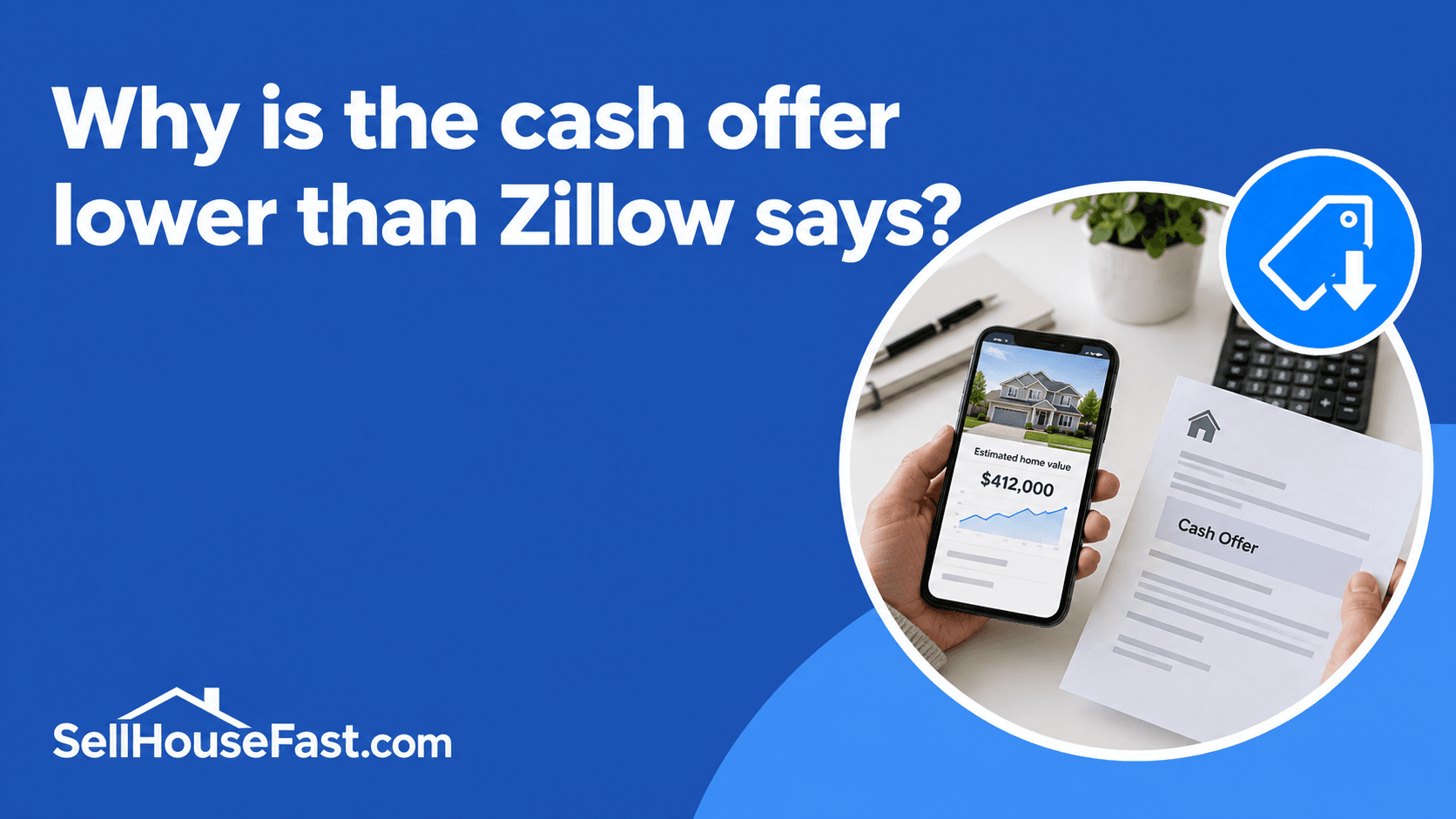
You checked Zillow. It says your house is worth $300,000. Then a cash buyer offers you $200,000, and your first thought is: are you kidding me?
That reaction is completely fair. But the gap between those two numbers isn't a trick. Once you see what's inside each number, the math looks very different, and you can decide which path actually puts more money in your pocket for your situation.
A Zillow Estimate Is Not an Offer
Online estimates are computer guesses built from public records and recent nearby sales. They have never walked through your front door.
They don't see the roof that's leaking, the 1990s kitchen, the foundation crack, or the tenant who stopped paying. They assume your home is in typical, move-in condition. If it isn't, the real market value is lower before anyone even makes an offer.
Think of the estimate as the price of a polished version of your house. A cash offer is the price of your house exactly as it sits today.
You Skip the Repairs. The Buyer Takes Them On.
When you sell for cash, you sell as-is. No contractors, no inspections to fix, no paint, no cleanout. You can leave behind what you don’t want.
Someone still has to pay for that work, though. The investor does, and their offer reflects it. A $35,000 roof and HVAC job doesn’t disappear. It just moves from your bank account to theirs.
The investor also carries the risk. If the plumber opens a wall and finds a bigger problem, that’s their cost, not yours.
The Costs a Listing Price Doesn’t Show You
The price on a listing is not what you take home. Before you see a dollar, a traditional sale usually takes out agent commissions, often around 5 to 6 percent combined. Then come seller closing costs like title, transfer taxes and fees, which commonly add another 1 to 3 percent.
Then there’s time. Every month your house sits on the market, you’re still paying the mortgage, taxes, insurance and utilities. Add buyer requests after the inspection, and the occasional deal that falls apart when financing doesn’t come through.
A cash sale typically has no commissions, and many cash buyers cover the closing costs. So the number on the offer is much closer to the number you actually keep.
How Investors Actually Build Their Offer
Most investors start with one number: the ARV, or after-repair value. That’s what your home should sell for once it’s fully fixed up. We break down the full process in How Real Estate Investors Evaluate Properties for a Cash Offer.
Many then use a rule of thumb called the 70 percent rule. They take 70 percent of the ARV and subtract the repair costs.
Offer = (ARV × 0.70) − Repairs
That 30 percent covers their own selling costs, holding costs, financing, the risk of surprises, and a profit that makes the deal worth doing. (Curious where that profit comes from? Read How Real Estate Investors Actually Make Money.) Every investor runs the numbers a little differently, and some pay more in strong markets. But this is why an honest cash offer will almost always come in under the retail estimate.
The Real Math: Listing vs. Cash
Here’s an example. Say Zillow shows $300,000, but your house needs about $35,000 in repairs to sell at that price.
List with an agent
- Sale price: $300,000
- Repairs before listing: −$35,000
- Agent commissions (about 5.5%): −$16,500
- Seller closing costs: −$6,000
- Holding costs (4 months): −$8,000
- Buyer repair credits: −$4,000
- What you walk away with: $230,500
- Time to close: 3 to 5 months
Sell for cash
- Sale price: $200,000
- Repairs, commissions, closing costs, holding costs, and buyer repair credits: $0
- What you walk away with: $200,000
- Time to close: As little as 2 to 3 weeks
The gap that looked like $100,000 is closer to $30,000. For that difference, the cash seller skips the repairs, the showings and the waiting, and gets a firm closing date. See How Long Does It Take to Close a Deal for what that timeline looks like. These numbers are only an illustration. Yours will depend on your home, your market and your timeline.
So Is a Cash Offer Right for You?
If your home is in great shape and you have months to wait, listing with an agent may net you more. That’s the honest answer.
A cash sale makes sense when speed, certainty or simplicity matter more than squeezing out the last dollar. That’s often true if you inherited a property, you’re going through a divorce, you’re behind on payments, you’re tired of being a landlord, or the house needs work you can’t afford or don’t want to manage.
The smartest move is to know both numbers. Get a cash offer, compare it to what a listing would really net you, and choose with your eyes open.
See Your Real Number
At SellHouseFast, you can get offers from verified cash buyers in one place, with no obligation and no pressure. Compare them side by side, ask questions, and only move forward if the numbers work for you.
Click Get Offers to see what your house is really worth as-is, today.
Read more such articles
How Long Does It Take to Close a Deal
24 Ago, 2026.


How Real Estate Investors Actually Make Money
12 Ago, 2026.